Why I Built a Rocket Money Alternative (Without the Bank Login)
58% of people won't link their bank account to Rocket Money. I'm one of them. Here's why I built SubGrade — and how it works without your credentials.
Saidul Islam
Author
I was paying $274 a month in subscriptions. I didn't know that until I actually sat down and counted.
Not $274 in big things. $274 in $9.99 here, $14.99 there, $4.99 for something I used twice in January. Each one small enough to ignore. Together, more than my electric bill.
So I did what everyone tells you to do. I tried Rocket Money.
What Rocket Money Does Well
I want to be fair here, because Rocket Money is genuinely good at what it does.
It syncs to your bank and credit cards, automatically scans your transactions, and surfaces every recurring charge — including ones you've forgotten about. The UI is clean. The cancellation concierge feature (where they actually call and cancel on your behalf) is legitimately useful. If you've ever tried to cancel a gym membership over the phone, you know how valuable that is.
For a lot of people, Rocket Money is the right answer. It works, it saves money, and the premium tier ($6–$12/month) is worth it if you hate dealing with this stuff.
But I'm not most people.
The Part Nobody Talks About
Here's what the Rocket Money onboarding looks like: enter your bank credentials, connect your accounts, grant read access to your full transaction history.
I closed the app.
I'm not saying Rocket Money is unsafe. Their security is enterprise-grade. But a 2024 PYMNTS survey found that 58% of consumers refuse to link their bank accounts to third-party financial apps. That's not paranoia — that's a reasonable risk calculation. You're handing over login credentials (or Plaid access) to a company whose business model includes selling anonymized spending data to financial partners.
Maybe that's fine for you. I couldn't get past it.
And when I looked for alternatives — apps that tracked subscriptions without needing bank access — I found a graveyard of abandoned projects and apps with 2-star reviews. The few decent ones just logged your subscriptions manually, with no intelligence behind them.
The Gap I Kept Running Into
Manual tracking is fine for the first week. You open the app, enter Netflix, Spotify, iCloud. You feel organized.
Three months later, you've forgotten about the meditation app you downloaded during a rough patch, the newsletter you paid $100/year for, the "free trial" that converted to $12.99/month in March.
What I wanted wasn't just a list. I wanted a system that told me whether each subscription was worth it. Not just "you're paying $X" but "you're paying $X and using it N times per month, which means each use costs you Y."
That changes the question entirely.
The Cost-Per-Use Idea
I started thinking about subscriptions the way you'd think about a gym membership.
If you go to the gym 20 times a month and pay $50, that's $2.50 per visit. If you go twice and pay $50, that's $25 per visit. Same membership, completely different value.
The formula is simple: monthly cost ÷ times used per month = cost per use.
Netflix at $17.99/month. If you watch five movies a month — maybe two hours each, so ten hours of content — that's $1.80 per movie. For comparison, renting a movie on Apple TV costs $3.99–5.99. Netflix is genuinely worth it.
Spotify at $11.99/month. If you listen for two hours a day, that's sixty hours a month. Cost per hour: $0.20. That's a grade-A subscription by any measure.
Some meditation app at $12.99/month that you open on the first of each month to feel less guilty: cost per use is $12.99. Might as well buy a book.
The cost-per-use method isn't complicated, but doing it manually for twelve subscriptions every month is tedious enough that nobody does it.
What I Found When I Looked Harder
I'm a developer. When I couldn't find the tool I wanted, I started building it.
The technical challenge wasn't the math — division is easy. It was figuring out how to get the usage data without requiring bank access, without being creepy, and without turning it into a second job for the user.
The answer ended up being simpler than I expected: just ask. Not in an annoying way — in a quick, frictionless way that takes ten seconds and becomes habit.
You log your Netflix watch. It takes three taps. After a few weeks, the app has enough data to give you a real signal. Not a perfect signal, but enough to make a decision.
What Good Alternatives Actually Need
I spent about three months looking at every subscription tracker I could find. Bobby (which I cover in detail in my Bobby app comparison) was the closest thing to what I wanted — privacy-first, manual, no bank sync. But it doesn't tell you anything about value. It just lists what you're paying.
Truebill (now Rocket Money) goes the other direction — automated detection, bank sync required.
The gap between "here's your list" and "here's whether it's worth it" is where most apps fail.
A good subscription tracker, in my view, needs to do five things:
- Track what you're paying without requiring bank credentials
- Track how often you actually use each subscription
- Turn that into a per-use cost
- Grade the subscription against a clear benchmark
- Tell you what to do about the bad ones
Points 1 and 2 require some manual input — that's the tradeoff. Points 3, 4, and 5 are where software can actually add value.
The Grade System
The grading benchmarks I settled on came from thinking about what you'd pay for equivalent value on a per-use basis:
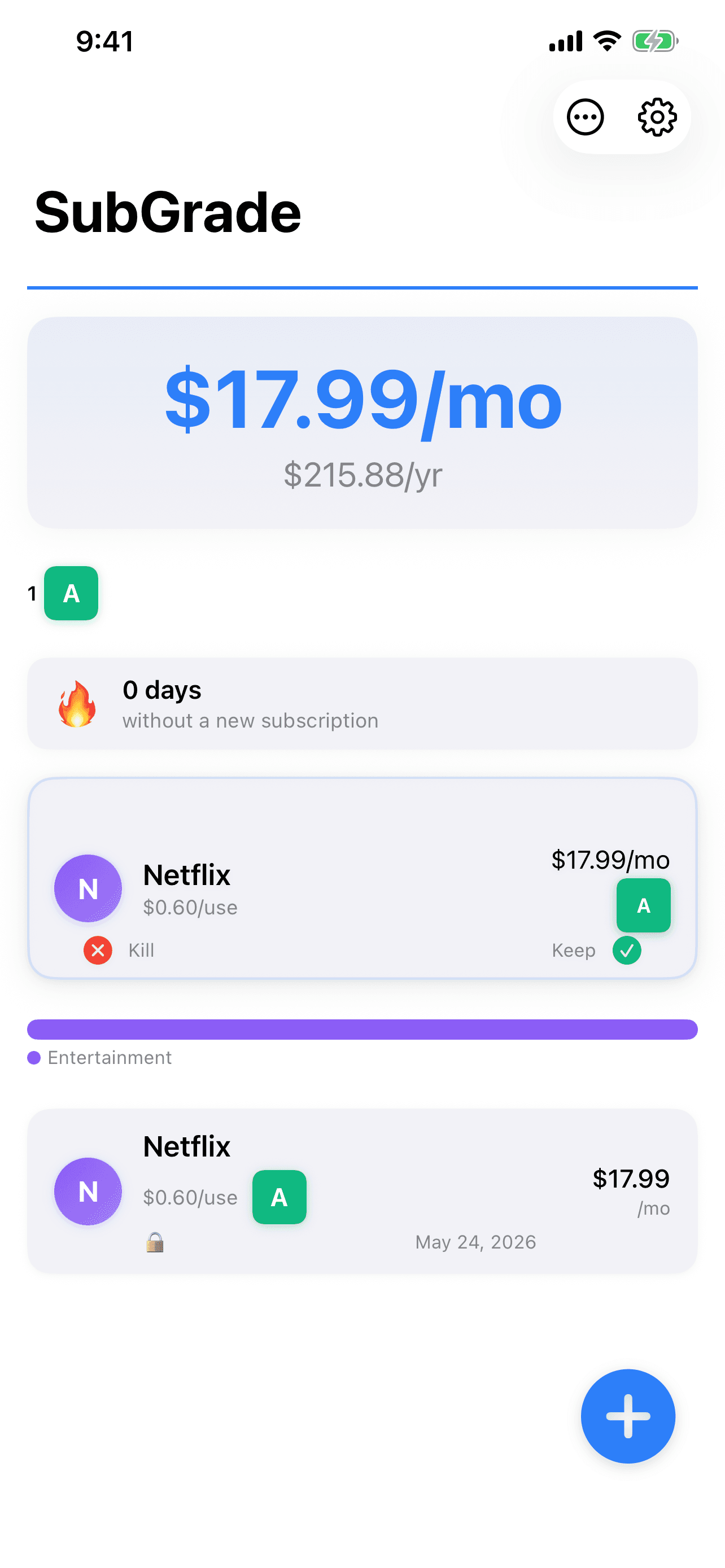
- A (under $1/use): You're getting a deal. Keep it.
- B ($1–$5/use): Still reasonable. Worth keeping unless you're cutting.
- C ($5–$15/use): Starting to question it. Is there a cheaper alternative?
- D ($15–$30/use): Hard to justify. Consider canceling or downgrading.
- F (over $30/use): Cancel immediately. You're paying more per use than buying outright would cost.
These aren't arbitrary. A D or F subscription is almost always one of two things: something you've outgrown (you used to use it, now you don't) or something you signed up for during a different season of life and forgot to cancel.
Section 5: Enter SubGrade
After building and using this system for about a year — first in a spreadsheet, then in a rough prototype — I shipped it as SubGrade.
SubGrade is the app I originally wanted to find. It works entirely without bank credentials. You add subscriptions manually (which takes about two minutes), log your usage as you go, and it calculates your cost-per-use and assigns grades automatically.
No Plaid. No bank login. No transaction history sitting on someone else's server.
The privacy tradeoff is real: you have to actually log your usage. But in practice, that's a feature. The moment you open the app to log a use, you're making a conscious decision. That's different from passive tracking, which often misses context (did you actually watch that thing, or did it autoplay in the background?).
The Cancellation Problem
One thing Rocket Money does that I genuinely envy is the cancellation concierge. Canceling subscriptions is genuinely annoying — not impossible, but annoying enough that most people put it off.
SubGrade takes a different approach. For each subscription you're considering canceling, there's a cancel guide — the exact steps, URL, or phone number to kill it without getting trapped in a retention flow. No one calls on your behalf, but the friction is reduced enough that most people just do it.
Who Should Use Rocket Money vs. SubGrade
Use Rocket Money if:
- You're okay linking your bank account
- You have a lot of subscriptions and want automated detection
- You want someone else to handle cancellations
- You prefer a more hands-off approach
Use SubGrade if:
- You won't link your bank account (you're in that 58%)
- You want to know which subscriptions are genuinely worth what you're paying
- You value privacy over automation
- You want a one-time-purchase app, not another subscription
I built SubGrade because I needed it. Most of the people I've talked to who use it feel the same way — they weren't looking for a bank-connected financial dashboard. They were looking for a simple, honest answer to a simple question: is this subscription worth it?
Turns out that question is harder to answer than it should be. But it doesn't have to be.
One useful thing a week. Nothing else.
I test these tools on real work and write up what actually held up. No roundups I have not used, no affiliate padding. Unsubscribe in one click.