Are Your Streaming Subscriptions Worth It? A Cost-Per-Use Reality Check
Netflix + Hulu + Disney+ + Max + Peacock adds up to $73/mo. Here's the cost-per-use math on each one so you know which to keep and which to cut.
Saidul Islam
Author
Let's do some uncomfortable math.
Netflix is $17.99 a month. Hulu with no ads is $17.99. Disney+ is $13.99. Max is $15.99. Peacock Premium is $7.99.
If you have all five — and a lot of households do — you're paying $73.95 a month on streaming video. That's $887.40 a year. More than most people spend on clothes.
Nobody sat down and decided to spend $887 a year on streaming. It happened one "free trial" at a time.
The question isn't whether to cancel everything. Some of these are genuinely worth it. The question is which ones, and the cost-per-use method is how you find out.
The Formula
Monthly cost ÷ times used this month = cost per use.
"Times used" for streaming means distinct viewing sessions — a movie, a few episodes, a sports event. Not total hours (though you could use that). Consistent unit, applied to all of them.
Let's run the numbers.
Netflix ($17.99/month, Standard)
Netflix has the deepest library of any streamer for scripted originals and licensed content. If you watch two or three things a week — say ten sessions a month — you're paying $1.80 per session. Grade B. Reasonable.
If you watch something every other day (fifteen sessions/month), you're at $1.20/session. Grade A. Genuinely good value.
The problem: Netflix increased prices three times between 2022 and 2025. The Standard plan that was $13.99 in 2022 is $17.99 now. Same content pipeline, higher price. If your usage hasn't changed, your grade has quietly slipped.
The honest verdict: Netflix earns a B or A for active households. If you're watching fewer than five things a month consistently, it's a C or D and you should ask yourself why you're keeping it.
Hulu No-Ads ($17.99/month)
Hulu's advantage is next-day broadcast TV — if you care about current-season network shows, nothing else matches it. It's also where FX originals land, which is consistently some of the best TV being made.
But Hulu's library has significant gaps. Anything MCU-adjacent goes to Disney+. A lot of content has short windows before it's removed. The interface, even after years of complaints, remains less intuitive than Netflix or Max.
At $17.99 with no ads, the math is the same as Netflix. Ten sessions/month: $1.80/session, Grade B. But the median Hulu user doesn't watch ten things a month on Hulu — they have it as a "sometimes" service or because of a bundle deal.
If you're in a Disney Bundle (Disney+/Hulu/ESPN+), the individual cost attribution is murkier. The bundle runs $24.99/month — you're effectively getting Hulu for about $7/month depending on how you weight it. That changes the math significantly.
The honest verdict: If you have the Disney Bundle, Hulu's marginal cost is low enough that the calculation is less critical. Standalone Hulu at $17.99 is only earning an A or B for households who actively watch current-season broadcast TV.
Disney+ ($13.99/month)
Disney+ is the most polarizing service on this list.
If you have kids under 12, Disney+ is one of the highest-value subscriptions you can have. The Pixar library alone justifies it. Add Star Wars, Marvel, Disney classics, National Geographic — the kid-rewatch factor means you're getting hundreds of views from content you paid for once.
If you don't have kids and you're not invested in the MCU or Star Wars universe, Disney+ has a thinner content slate for you specifically. The adult originals haven't matched Netflix or Max for critical or cultural impact.
At $13.99 for a family that puts it on twice a day (60 sessions/month), cost per session is $0.23. Grade A, obviously.
At $13.99 for a single adult who watches maybe four things a month (all MCU releases), cost per session is $3.50. Grade B. Still defensible if you care about the content.
The honest verdict: Disney+ grades highly for families and MCU/Star Wars fans. For everyone else, it's a situational B or C depending on what's currently releasing.
Max ($15.99/month, with ads)
Max (formerly HBO Max, formerly HBO Go) has what might be the best-quality-per-title ratio in streaming. HBO content — The Last of Us, Succession, The Wire, Sopranos — is consistently at the top of the medium. If prestige TV matters to you, Max is hard to skip.
The problem is release cadence. HBO originals drop slowly. There are weeks with nothing new worth watching, then a six-week burst where Max is all anyone talks about.
For someone who watches a lot, that might average out fine. For casual viewers, Max can sit idle for two months and then get used heavily for one. Average that out and you might land at five sessions a month: $3.20/session. Grade B.
At $15.99 with ads, you're also contending with ads. Ad-free is $20.99. If you're going ad-free, you need to be watching more to justify the cost bump.
The honest verdict: Max earns a B for engaged viewers who watch current prestige TV. If you're waiting for one specific show and keeping it on otherwise, cancel between seasons and resubscribe.
Peacock ($7.99/month)
Peacock is the cheapest of the major streamers and it shows. The library leans on NBC properties, older reality content, and Premier League soccer.
At $7.99/month, the math is forgiving. Four sessions a month: $2.00/session. Grade B. Even at two sessions, $4.00/session is still a B.
But "forgiving math" can mask a bad subscription. $7.99/month is only $96/year. That's low enough that most people never actively cancel it — it just keeps charging. If you're using it for one thing (a specific sports league, or The Office reruns), ask yourself whether the cost is actually worth it or whether you're just used to having it.
The honest verdict: Peacock can be genuinely good value for sports fans (especially Premier League) or NBC-heavy viewers. For everyone else, it's often an "I'll get to it" service that never quite gets used enough to justify even its low price.
The Overlap Problem
Here's where it gets wasteful: most of these services duplicate each other in important ways.
Netflix and Max both do prestige drama. If you're watching HBO originals on Max and Netflix originals on Netflix, great — they're complementary. But a lot of people watch primarily on one and have the other out of habit or FOMO.
Disney+ and Hulu overlap almost completely for certain content types (they're owned by the same company and share some libraries in the bundle).
Hulu, Peacock, and Paramount+ all compete for the "next-day broadcast TV" audience. You probably need at most one of these.
The streaming stack that makes sense for most households isn't five services. It's two or three, chosen deliberately.
A Practical Approach: Rotate Instead of Stack
One approach that changes the math: don't keep all of them simultaneously.
Keep Netflix year-round as your baseline (Grade A for most active households). Then rotate through Max, Disney+, and Hulu based on what's currently releasing. Watch one season of something, cancel, come back three months later when the next thing you care about arrives.
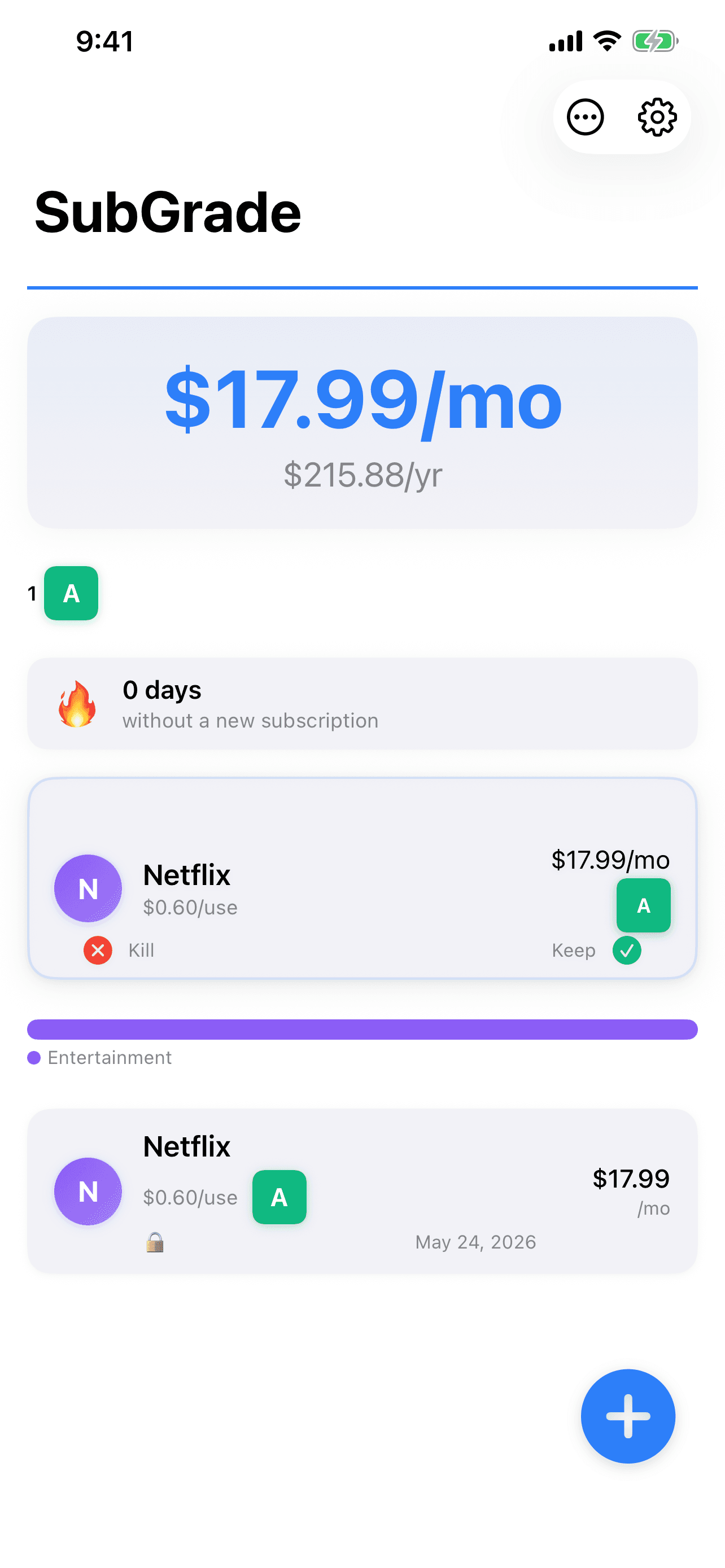
This does require remembering to cancel. But subscription management apps — like SubGrade — can surface upcoming billing dates so you're not getting charged on autopilot.
Run Your Own Numbers
The averages above are useful context, but your streaming grades are personal. What matters is your actual usage, not the average.
If you genuinely watch Netflix every night, it's a grade-A subscription — no question. If it's on as background noise twice a month, it's probably a D.
The cost-per-use method is the same for every subscription category. You apply it, you get a number, and the number doesn't lie. Your feelings about a streaming service don't change what you're paying per use. The grade does.
Take twenty minutes this week. Count your actual sessions last month for each service. Do the division. You'll probably cut at least one — and you'll feel better about the ones you keep.
One useful thing a week. Nothing else.
I test these tools on real work and write up what actually held up. No roundups I have not used, no affiliate padding. Unsubscribe in one click.