Fitness App Subscriptions: Which Ones Are Actually Worth Paying For?
Peloton + Nike + MyFitnessPal + Strava adds up fast. Most people use one or two and forget the rest. Here's how to find your real cost-per-use.
Saidul Islam
Author
Fitness subscriptions are in a category of their own when it comes to waste.
Other subscriptions at least give you something passively — Netflix shows up whether you show up or not. Fitness apps charge you even on the days you skip the workout. And there's a specific psychological trick at play: the guilt of having a $44/month Peloton subscription that you're not using is often enough to make you keep paying it — the theory being that maybe the financial pressure will motivate you.
It doesn't. The research on "commitment devices" in exercise is mixed at best. What actually happens is you pay for eighteen months of Peloton, use it for three, feel guilty for fifteen, and eventually cancel.
Let's run the real numbers.
Peloton App ($44/month, All-Access)
Peloton's app membership gives you access to their full content library without the hardware. Cycling, running, strength, yoga, meditation, stretching — it's genuinely comprehensive.
At $44/month, the math requires consistent use to hold up.
If you work out five days a week, that's roughly 22 sessions per month. Cost per session: $2.00. That's a solid B.
If you use it three days a week (12 sessions): $3.67/session. Still B.
If your average month is more like six sessions because life happens: $7.33/session. That's a C sliding toward D.
The honest reality: most people who sign up for Peloton's app are aspirationally buying five-days-a-week use. Their actual use is closer to six to ten sessions per month. At ten sessions, you're at $4.40/session — borderline B. At six sessions, you're at $7.33 — a C.
The verdict: Peloton App earns a B for consistent exercisers (10+ sessions/month) and a C or D for aspirational subscribers. Don't pay $44/month to feel guilty.
Nike Training Club (Free, was $14.99/month)
Nike Training Club went free in 2020 during the pandemic and never went back to paid. As of 2026, it's still free.
This one is easy: cost per use is $0. Grade A by definition. If you're paying for a fitness app and haven't tried NTC, try it first.
The content isn't as extensive as Peloton, but the guided workouts are genuinely good, especially for bodyweight and HIIT training. No equipment required for most workouts. The trainers are actual Nike athletes, not just influencers.
The verdict: Use this before paying for anything. Seriously.
MyFitnessPal Premium ($19.99/month or $79.99/year)
MyFitnessPal is the dominant calorie and macro tracking app. The free version is functional — you can log food, track calories, and see basic stats. The premium version adds barcode scanning without limits, macro goal customization, a food analysis dashboard, and some workout planning features.
If you're actively tracking macros for a specific goal (cut, bulk, body recomposition), premium MyFitnessPal earns its keep. You're opening it daily — at least twice (meals and end-of-day review). That's 60+ sessions per month. At $19.99/month: $0.33/session. Grade A.
If you use MFP casually — logging on good days, ignoring it on bad days — the math collapses. Fifteen sessions: $1.33/session. Still a B, but you're probably not getting full value from premium features.
The verdict: Pay for premium only if you're actively tracking macros at least 15 days per month. Otherwise the free version is sufficient and the $19.99/month is wasted.
Strava ($11.99/month or $79.99/year)
Strava is the social network for runners and cyclists. The free tier is now significantly limited — you can still log activities, but route planning, segment comparisons, and heart rate analysis require premium.
If you run or cycle seriously — four or more times a week — Strava is almost certainly worth it. You're posting every workout, analyzing your data, competing on segments. At four workouts/week (16/month), that's $0.75/session. Grade A.
If you run occasionally or use Strava mainly for the social feed, the free tier probably covers your needs. The $11.99/month is paying for features you're not using.
The verdict: Pay for Strava only if you're tracking four or more activities per week and using the analysis features. Casual runners should stick to the free tier.
The Overlap Problem in Fitness Apps
Here's where the real waste hides: fitness apps serve overlapping purposes, and most people never notice.
A typical accumulation:
- Peloton ($44/month) for guided workouts
- MyFitnessPal Premium ($19.99/month) for nutrition
- Strava ($11.99/month) for run tracking
- Apple Fitness+ ($9.99/month) included in Apple One
- Some random meditation app ($9.99/month) purchased after a stressful week
That's $106.96/month — $1,283.52/year — on fitness and wellness apps. Not counting the gym membership.
The overlap: Peloton includes guided runs that make Strava redundant for some users. Apple Fitness+ covers many of the same workout types as Peloton. Strava and Apple Watch metrics overlap substantially.
Most people use one fitness app consistently and the others occasionally. The consistent one is probably worth its cost. The occasional ones probably aren't.
Running the Math on Your Stack
The cost-per-use method applies here exactly as it does elsewhere. Monthly cost ÷ actual sessions this month = cost per use. Grade against the benchmarks.
What makes fitness apps different is the "guilt keeping" phenomenon. Be honest about whether you're keeping a subscription because you use it or because canceling it feels like giving up on your health goals. Those are not the same thing.
A grade-F fitness subscription that you keep out of guilt isn't motivating you. It's just costing you $44/month to feel bad.
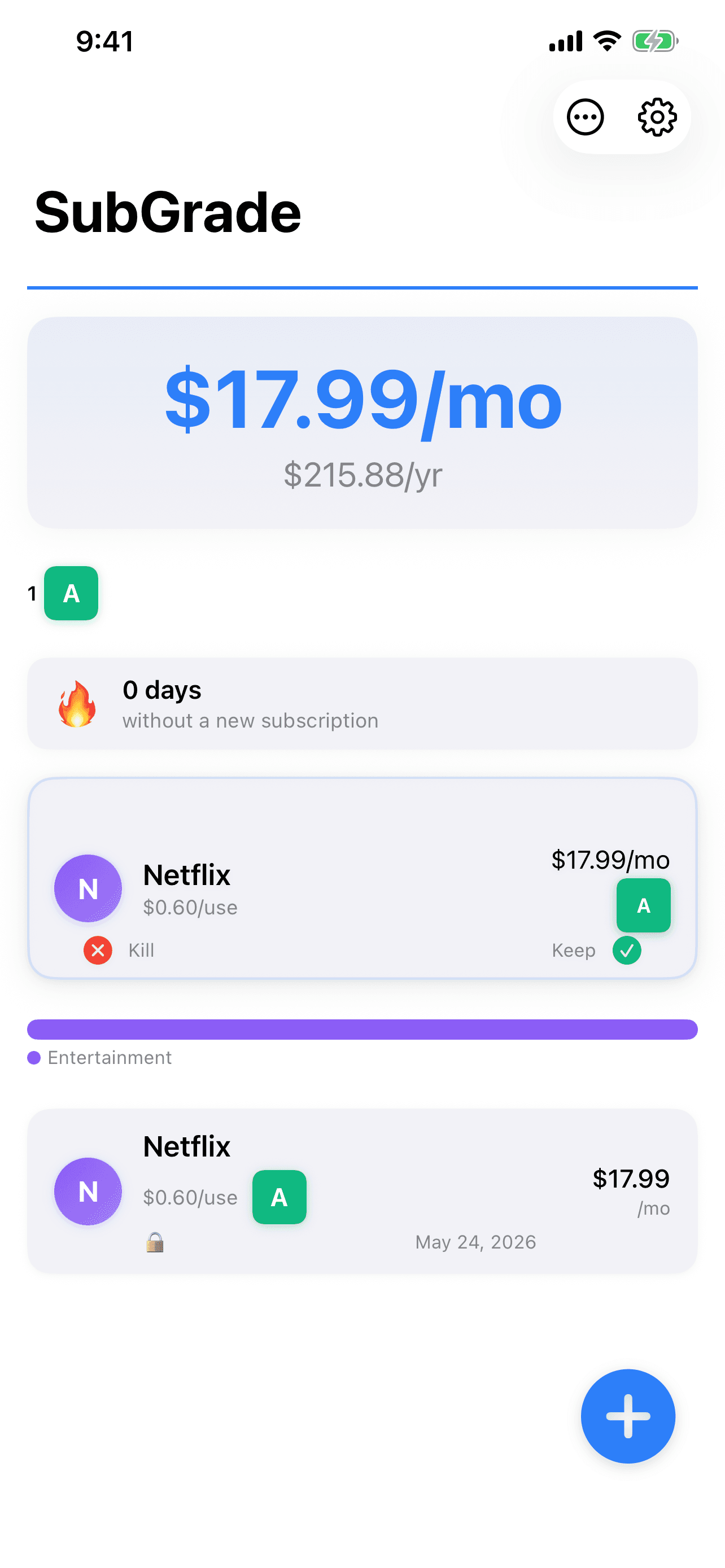
SubGrade tracks your actual usage, not your intended usage. That gap — between what you plan to do and what you actually do — is where most fitness subscription money disappears.
The Practical Starting Point
Before paying for any fitness subscription, exhaust these free options first:
- Nike Training Club (free, genuinely good)
- YouTube fitness channels (free, infinite variety)
- Apple Fitness+ if you're already in Apple One ($37.95/month for six Apple services)
- Basic Strava tier for casual runners
Add paid subscriptions only when a specific feature you actually use — not plan to use — justifies the cost. And track that usage. If you're paying $44/month for Peloton, you should be able to tell me how many sessions you did last month without looking it up. If you can't, that's your answer.
One useful thing a week. Nothing else.
I test these tools on real work and write up what actually held up. No roundups I have not used, no affiliate padding. Unsubscribe in one click.