Family Subscription Audit: Stop Paying Twice for the Same Thing
Households often pay for Netflix twice, two Spotify accounts, separate iCloud plans. A family subscription audit typically saves $50-100/mo. Here's how.
Saidul Islam
Author
Here's a conversation that happens a lot:
"Wait, do we have Netflix?" "Yeah, I have Netflix." "Oh. I've been paying for Netflix too."
Two accounts. Two $17.99/month charges. $431.76/year spent on two accounts that could have been one account.
This is the family subscription audit problem, and it's not just Netflix. It shows up in music streaming, cloud storage, grocery delivery, news subscriptions, password managers, VPNs, and a dozen other categories where household members independently signed up for the same service without coordinating.
The typical household with two adults and a couple of teenagers is paying for somewhere between four and eight overlapping subscriptions. Fixing it takes a Saturday morning and saves a meaningful amount of money.
Why This Happens
Subscriptions used to be easier to share or harder to accidentally duplicate. A DVD subscription was physical — you only had one account.
Digital subscriptions are different. They're signed up for individually, charged to individual cards, and used on individual devices. They don't appear on a shared statement. They don't announce themselves.
The two most common duplication patterns:
New relationship / new household. Two people who each had their own streaming accounts, music accounts, and cloud storage move in together and keep all their individual subscriptions instead of consolidating.
Account drift. One person sets up a shared family plan (say, Spotify Family). Over time, another family member decides it's easier to create their own individual account rather than ask to be added to the family plan. Now you're paying for a family plan and an individual account.
Both patterns are predictable and both cost real money.
The Full Audit: What to Look For
Go through these categories as a household, not individually. That's the only way to catch duplicates.
Streaming Video
Netflix, Disney+, Hulu, Max, Peacock, Paramount+, Apple TV+. These are the most common duplicates.
Check: Does every adult in the household have their own separate account? If yes, you're almost certainly wasting money. Most streaming services now support multiple profiles within a single account. Netflix Standard supports two streams simultaneously. Disney+ Family supports four. One account, multiple profiles, one bill.
The exception: Netflix's password sharing crackdown (fully implemented in 2024) means that accounts limited to one household address can only be used at one location. If you have a college student or a parent in another city who was using your Netflix, that's now a separate charge or they need their own account.
Fix: Identify the household's preferred plan for each service, cancel duplicates, make sure everyone has their own profile.
Music Streaming
Spotify, Apple Music, Amazon Music, YouTube Music. Nearly all of them offer family plans that are significantly cheaper than multiple individual accounts.
Spotify Individual: $11.99/month. Spotify Duo (2 people, same address): $16.99/month — that's $8.50 per person, 29% cheaper than two Individual plans. Spotify Family (up to 6 people): $17.99/month — $3.00 per person.
If you have two individual Spotify accounts: $23.98/month. Spotify Duo: $16.99/month. Savings: $6.99/month, $83.88/year. Just for consolidating.
Apple Music: Individual $10.99, Family (up to 6) $16.99. Two individual accounts: $21.98. Family: $16.99. Savings: $5/month, $60/year.
Fix: Pick one music service for the household. Get the family plan. Cancel individual duplicates.
Cloud Storage
iCloud, Google One, Dropbox, OneDrive. This one is particularly bad because each person independently hits their storage limit at different times and upgrades individually.
Typical household:
- Person A: iCloud 200GB ($2.99/month) because their iPhone filled up
- Person B: iCloud 50GB ($0.99/month) — also close to full
- Person A also: Google One 200GB ($2.99/month) from when they used Android
- Person B also: Dropbox Plus ($11.99/month) from a work project years ago
Total: $18.96/month for four overlapping cloud storage subscriptions.
Apple's iCloud+ 2TB plan at $9.99/month can be shared with up to five family members via Family Sharing. That replaces both individual iCloud plans and gives you more storage. Google One 2TB at $9.99/month similarly covers a family.
Fix: Audit all cloud storage subscriptions across all household members. Consolidate to a single family plan for your primary cloud. Cancel duplicates.
Password Managers
1Password, LastPass, Bitwarden, Dashlane. These are often set up individually.
1Password Families ($4.99/month) covers five family members. If two people in a household each have 1Password Individual ($2.99/month), they're paying $5.98/month for two separate accounts when one Families account would cover both for less.
Bitwarden is worth mentioning: the free tier is genuinely excellent and includes most features individuals need. If you're paying for a password manager, confirm you actually need the premium features.
Fix: One household password manager. Family plan if the math works out.
Grocery Delivery
Instacart+, DoorDash DashPass, Walmart+, Amazon Prime. The overlap here is delivery memberships, and it's common for two adults in a household to each pay for their preferred delivery service.
Amazon Prime ($14.99/month or $139/year) includes Prime Video, free shipping, Prime Pantry. It's a household subscription — one account serves the whole household.
Instacart+ ($9.99/month) can be shared with one other household member. If two people each have it: $19.98/month. One shared account: $9.99/month.
Fix: Pick the delivery services you use most and use household accounts instead of individual ones.
The Cost-Per-Use Check on Family Plans
Family plans are usually obviously worth it when you're replacing two individual accounts. But run the numbers using the cost-per-use method to confirm.
Example: Apple One Premier ($37.95/month for up to 6 family members) includes Apple Music, Apple TV+, Apple Arcade, iCloud 2TB, Apple Fitness+, and Apple News+.
If your household is paying:
- Apple Music Family ($16.99/month)
- iCloud 2TB individually ($9.99/month each, so $19.98 for two)
- Apple TV+ ($9.99/month)
That's $46.96/month for three services. Apple One Premier at $37.95/month is cheaper and adds three more services.
But: if you're only using Music and iCloud, and nobody watches Apple TV+ or plays Arcade games, you're not "getting more value" from the bundle — you're just paying less for a set of services some of which go unused.
Bundle math requires honest accounting of what you actually use, not what's included.
Who's Actually Using What
The hardest question in a family subscription audit isn't "are we paying twice?" — it's "who's actually using this and how much?"
A good way to audit this concretely: for each subscription, go around the household and ask each person to name one specific thing they used it for in the last 30 days. Not "I use Netflix all the time" — name one actual show or movie.
If nobody can name something, that's your answer.
This works particularly well for:
- Streaming services ("what did you actually watch on Max last month?")
- App subscriptions ("what did you use this meditation app for recently?")
- News subscriptions ("name one article you read from your subscription")
The discomfort of the conversation is valuable. Subscriptions that survive this question are worth keeping. Subscriptions where everyone looks at each other and shrugs are not.
Doing the Audit Together
The most important logistical point: the audit only works if every person in the household participates. A solo audit of your own subscriptions will miss the duplicates, because the duplicates are on other people's cards and accounts.
Set aside an hour. Everyone opens their credit card app, PayPal, App Store subscription management (iOS Settings > your name > Subscriptions), and Google Play subscription management. Write down everything.
Then compare lists. The duplicates will be immediately obvious.
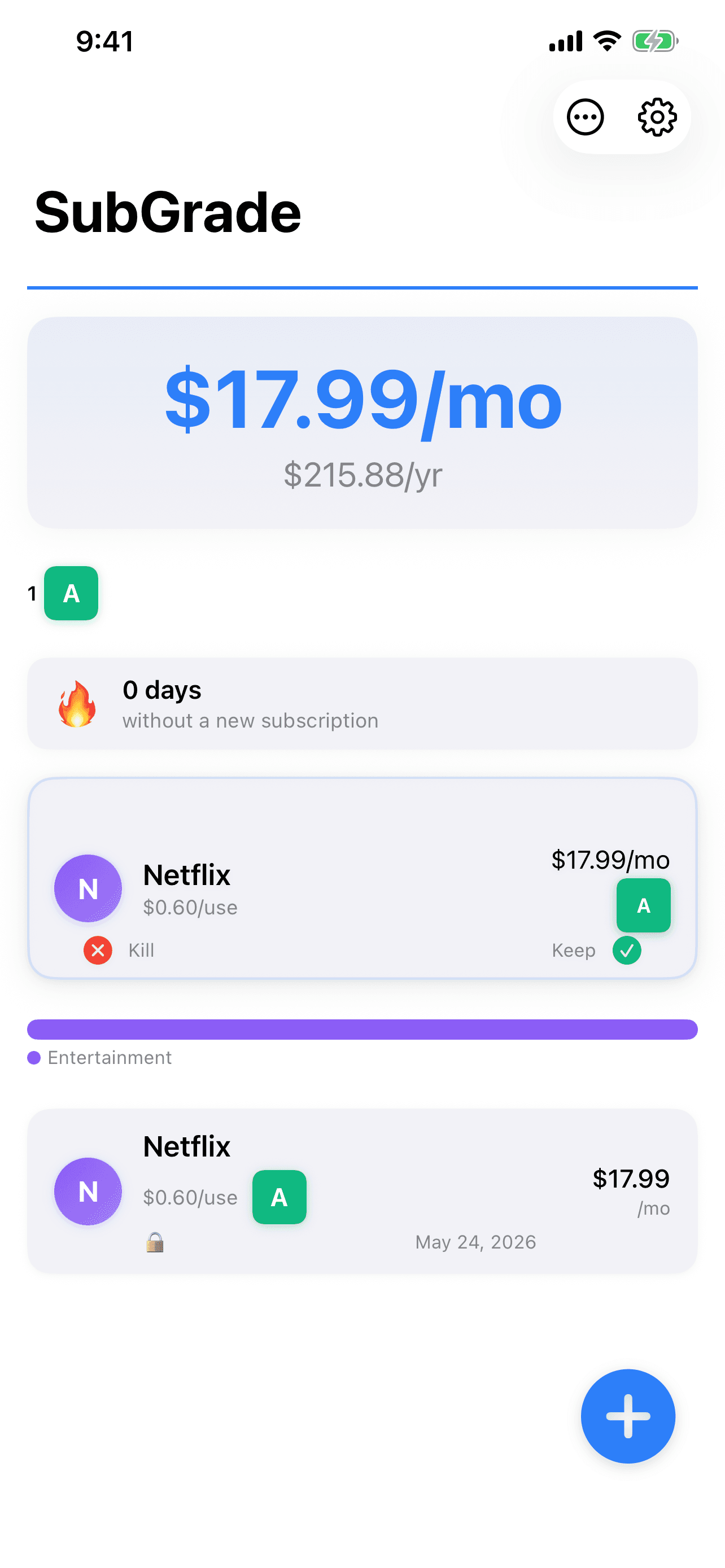
SubGrade is useful for tracking your share of household subscriptions — especially if you're splitting costs and want to see your true cost-per-use for services you're splitting. The app doesn't require bank access, so each person can track their own subscriptions and usage independently without worrying about sharing financial credentials.
What You'll Find
Based on talking to dozens of households who've done this audit: the typical two-adult household finds $40–$80/month in duplicate or redundant subscriptions on the first pass.
That's $480–$960/year going nowhere.
Most of it isn't any single egregious subscription — it's the accumulation of small duplicates. Two streaming services that could be one. Two cloud storage plans instead of a shared family plan. Two individual music accounts instead of a duo plan.
Nobody planned this. It just accumulated. But it un-accumulates pretty quickly once you actually look.
One useful thing a week. Nothing else.
I test these tools on real work and write up what actually held up. No roundups I have not used, no affiliate padding. Unsubscribe in one click.